Tuesday, July 16, 2013

The importance Of DUA


 Dua and Supplication, Make Time In your Day to remember Allah, And ask Him, For he Loves when His Muslimeen ask Him for anything, And He Gives Abundantly. BeCause Allah Is Merciful and Glorious. May he bestow his Mercy On all Muslims.

                        Ameen Ya Rab-ul-Alimeen


"And remember your Lord by your tongue and within yourself,
humbly and with fear without loudness in words in the mornings, 
and in the afternoons and be not of those who are neglectful.
Surely, those who are with your Lord (angels)
are never too proud to perform acts of worship to Him,
but they glorify His Praise and prostrate before Him.
"

The Noble Qur'an - Al-A'raf 7:205-206
------------------------------------------------------------------------------

"Supplication is the pith of worship."

Tirmidhi, Narrated Anas ibn Malik
----------------------------------------------------------------------

"No one offers a supplication without Allah bringing him what he asks
or keeping away from him a like amount of evil,
provided he does not ask for something sinful or for breaking ties of relationship.
"

Tirmidhi, Narrated Jabir ibn Abdullah
----------------------------------------------------------------

"If anyone finds pleasure in receiving an answer from Allah in times of difficulty,
he should make many supplications when times are easy."


Tirmidhi, Narrated AbuHurayrah, gharib tradition
----------------------------------------------------------------------

Sunday, July 14, 2013

THINGS WHICH DO NOT BREAK THE FAST, BUT WHICH ARE MAKROOH

THINGS WHICH DO NOT BREAK THE FAST, BUT WHICH ARE MAKROOH DURING SAUM
Some things, while not breaking the fast are nevertheless Makrooh to do during fasting.  Makrooh means detestable and in this context Makrooh things are sinful.  Makrooh things bring about a decrease in the committing of the Saum.  It is, therefore, essential to abstain from community Makrooh acts.  The following acts are Makrooh during fasting.

1) Tasting.  Tasting food, etc., is Makrooh if done unnecessarily.  If an ill-tempered husband shows his unjustified wrath when food has not been prepared to satisfy his taste, it will be permissible for the wife to taste the food while she is preparing it.  As long as nothing goes down her throat, her fast will be valid and her act of tasting will not be Makrooh.

2) Using powder or paste to clean the teeth.  If anything of these substances slips down the throat the saum is nullified.

3) Caressing, fondling or kissing the wife.  If ejaculation does not occurs, the saum will be valid.

4) To rinse the mouth at time other than when making wudu.

5) To put water in the nose at time other than when making wudhu.
6) To take ghusl merely for cooling.

7) To swim.

8) To unnecessarily apply ointment to the lips.  If, however, due to pair caused by cracked lips, ointment is applied, care should be taken to prevent licking the ointment.

9) To unnecessarily chew something to soften it, for example.

10) To eat when in doubt as regards the existence of Sahri time.  If later it transpires that Shari time had in fact expires, qadha will be obligatory.

11) To make Iftar (I.e. to break the fast) when in doubt as to the time of sunset.  If it transpires that the time when iftar was made the sun had not yet set.  Quadha will be obligatory.

12) Participating in un-Islamic activities such as watching television and playing games such as chess, draughts, monopoly, etc., The thawa of the Saum is destroyed by indulgence in such unlawful activities.

13) Gheebat or back-biting.

14) To gargle the mouth when making wudhu.

Allah Knows best, : source : Islamic Scholars 

things which do Not break the Fast

THINGS WHICH DO NOT BREAK THE FAST
1) Eating, drinking or indulging in sexual relation forgetfully.  This means that at the time of committing act.  One does not remember the fast.  However, if one continues even momentarily after recalling the fast, the Saum will be nullified.

2) Applying eye drops.

3) Water entering the ear.

4) Vomiting, no matter how much.  This refers to vomiting which is not self-induced.  For the rule regarding self-induced vomiting, (see above no.  11)

5) Smoke, which is inhaled unintentionally, not by one's volition or conscious action.

6) Applying Surmah into the eye.

7) Smelling anything fragrant providing that there are no vapors.

8) A food particle less than the size of a chana becoming unstuck from the teeth.

9) Swallowing saliva and slime.

10) Injection.  The injection of medicine into the body will not break the fast providing that the medicine does not reach the brain or stomach.

11) Blood in the saliva will not break the fast if the blood is less than the saliva.  This fact will be recognized if the taste of the blood is not discerned.

12) Using a miswak to clean the teeth even if the miswak is fresh and has a taste.

13) Breast-feeding the baby.

14) If during wudhu water slips down the throat while one does not remember the saum, the fast will not break.

15) Ejaculation of semen during sleep. 

16) Ejaculation caused by imagination.

17) Janabat or the state of Hadath-e-Akbar which is purified by ghusl. If one has not taken ghusl and Sahri time ends, the fast is valid.

Allah Knows Best,  :source Islamic scholars

Things that Break your Fast, (void Fast)

Ramadan: Rules of Fasting


THINGS WHICH BREAKS FAST
1) Eating or drinking breaks the saum.

2) Sexual intercourse even if there is no emergence of semen.

3) Smoking

4) Inhaling smoke by one's own action.  E.g. inhaling the smoke of incense, etc.

5) Application of medication into the anus.

 6) Swallowing any substance or object which is not normally, consumed as food or medicine, e.g. pebbles, paper, a com, etc.

7) Pouring oil into the ear.

8)Saliva mingled with blood will break- the fast if the taste of blood is discernible when swallowing.

9) Eating deliberately after having eaten mistakenly. (Eating mistake does not break the fast).

10) Water slipping down the throat while making wudhu even if not done deliberately.

11) Deliberately inducing oneself to vomit will break- the fast if the vomit is a mouthful.  If the emergence of vomit cannot be
restrained, the vomit will be said to be a mouthful.  Vomiting less than a mouthful will not break the fast even if it is deliberately induced


12) A food particle the size of a chana (about the size of a half a pea), becoming unstuck from the teeth and slipping down the throat.

13) Applying drops of medicine into the nostrils.

14) Masturbation. In addition to it nullifying the saum.  It is an immoral and a sinful act. 
The perpetrator has been cursed by Rasulullah (Sallallahu Alayhi Wasallam).

15) Medical test undertaken by women in which any instrument, etc.  Is internally inserted.

16) Ejaculation as a result of caressing and fondling the wife even if there was no sexual intercourse.

And of course Allah knows Best, and and is the best Judge.

Praying : Salat-Ul-Tasbih


Salatul Tasbih
For forgiveness of All Sins
Benefits of Salat-Ul-Tasbih
Our Beloved Prophet Mohammed (Sallallaho Alihiwassallam) said to his uncle (father’s brother) Sayyiduna Abbass (may Allah be pleased with him) Oh uncle shall I not give you Shall I not grant you Shall I not award you Shall I not do mercy on you When you do 10 things Allah will forgive your sins: of the future and of the past; new and old; those you have forgotten and those you did knowingly; big and small; hidden and revealed. Then he (Sallallaho Alihiwassallam) explained the taught the way to pray Salatul Tasbih and then said if you can pray this salah once a day, if you can not pray once a day then every Friday, and even if this is not possible then once a month and even if this is not possible then once a year and even if this is not possible then at least once in a lifetime (Abu’Dawood & Tirimzi)

How to perform Salatul Tasbih?
This salaat (namaz) is offered in four rakat at a time and can be read in any part of the day and night besides Zawal and Sunrise and Sunset makrooh times, keeping in mind the forbidden times for performing Salat (namaaz). But is is preferred before Zuhr (Fatawa Alamgeeri)

The Tasbih to be read in Salaat-Ul-Tasbeeh:
" Subhaan Allahi Wal Hamdulillahi Wa Laa ilaha illal Laahu Wallahu Akbar "

Method:
Goal is to recite above Tasbih 300 times in Four Rakah with the following method.
In the first rakaat, after reading Sana "Subhaana Kallahumma...", read the above tasbih 15 times.
Now recite Aaoz "Aoozubillah...", Bismillah "Bismillah...", Then read sura Fatiha and a Surah or minimum of three small Ayayhs then read the tasbih 10 times again.
Go to ruku saying Takbeer (Allah Hoo Akbar), after reciting "Subhaana Rabbiyal Azeem" minimum of three times read the tasbih 10 times in Ruku.
Saying "Samee Allahu Liman Hamidah Rabbana Lakal Hamdh" get up from ruku to qiyam position.
Now read the tasbih 10 times.
Go to Sajdah saying Takbeer (Allah Hoo Akbar) and after reciting "Subhaana Rabbiyal A'la" minimum of three times read the tasbih 10 times in Sajdah.
Now go after first Sajdah go to Jalsa (sitting position) saying Takbeer (Allah Hoo Akbar). Sitting in Jalsa read tasbih 10 times.
Go to sajda again saying Takbeer (Allah Hoo Akbar) and after reciting "Subhaana Rabbiyal A'la" minimum of three times read the tasbih 10 times in Sajdah again.
Get up to begin 2nd rakat saying Takbeer (Allah Hoo Akbar).
Do rakah #2 in same fashion, but before reading Bismillah "Bismillah...", and Surah Fatiha, read the tasbih 15 times. Follow the rest as you did in first Rakat.
After second Sajdah of Second Rakat sit in Qaidah Oola (first sitting) read Attahiyat, Durood and Dua then get up for 3rd rakaat without saying Salam.
Begin third Rakat, just like the first Rakat, with Sana "Subhaana Kallahumma...", read the above tasbih 15 times. Follow the rest as you did in first Rakat untill you sit for Qaidah Akihra (last sitting) after second sajdah of fourth Rakah.
In Qaidah Akihra Attahiyat, Durood, Dua finish Salah with Salam.

Special notes for Salat-Ul-Tasbih:
1) Do not count loudly. It will break Salah
2) Do not count on fingers or by holding a Bead Tasbih in hand. It is Makruh.
3) You may count by pressing the fingers as a reminder. For example if you are in Ruku. You me press pinky of your right hand first for the first count, then the finger next to it for second count, then the middle finger for third count, following this method untill you reach the pinky of left hand will give you an exact count of ten. Use the same method in Qayam, Sajdah and Jalsa.
4) If missed a count then make it up in the next posture. For example if forgot to recite Tasbih after Surah in Qayam. Then you may recite Tasbish 20 times instead of 10 in Rukuh after "Subhaana Rabbiyal Azeem". Missed Tasbih cannot be recited in Qayam after ruku and Jalsa between Sajdah. If you missed the Tasbih in Ruku then recite 20 in the first Sajdah instead of the Qayam after rukuh. Similarly if missed the Tasbih in first Sajdah then do not make it up in Jalsa. Instead recite missed tasbih in the second Sajdah. If Tasbih has been missed in last sajdah of second or fourth Rakah then you can recite the missed ones before Attahiyat in Qaidah.
5) If you miss a wajib in Salah and have to do Sajdah Sahaw. You dont have to recite Tasbih in Sajdah sahoo, since the 300 count has been estalished. But if you had missed Tasbih in any of the postures and remeber it now. Then you may recite the missed Tasbih in Sajdah Sahaw now.
6) It is preferable to recite after Surah Fatiha Sura Takathuur in the first raka’, Surah Wal A’sr in the second raka’, Surah Kaferoon (qul ya aiyuhal Kafiroon) in the third and Surah Akhlas (Qul hu Allah-hu ahd) in the fourth raka’. If one does not remember these surah they can recite the ones they prefer.

May Allah accept this dua’ (supplication) for the sake of the trustworthy PROPHET MOHAMMED (Allah’s Grace & Peace be upon him)

dua and supplications for the Month of Ramadan


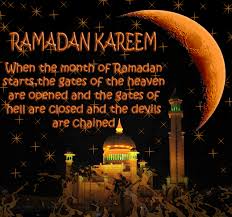
Ramadan Mubarak!

Ramadan Mubarak to all Muslim Brothers and Sisters! May we try and earn the most we can of Allah's Blessings & Mercy In this Holy Month  (Ameen)


Ramadan is a Time of Forgiveness, A time Of caring and Sharing and of being Thankful That we are Muslim .