Ramadan: Rules of Fasting |
THINGS WHICH BREAKS FAST
1) Eating or drinking breaks the saum.
2) Sexual intercourse even if there is no emergence of semen.
3) Smoking
4) Inhaling smoke by one's own action. E.g. inhaling the smoke of incense, etc.
5) Application of medication into the anus.
6) Swallowing any substance or object which is not normally, consumed as food or medicine, e.g. pebbles, paper, a com, etc.
7) Pouring oil into the ear.
8)Saliva mingled with blood will break- the fast if the taste of blood is discernible when swallowing.
9) Eating deliberately after having eaten mistakenly. (Eating mistake does not break the fast).
10) Water slipping down the throat while making wudhu even if not done deliberately.
11) Deliberately inducing oneself to vomit will break- the fast if the vomit is a mouthful. If the emergence of vomit cannot be
restrained, the vomit will be said to be a mouthful. Vomiting less than a mouthful will not break the fast even if it is deliberately induced
12) A food particle the size of a chana (about the size of a half a pea), becoming unstuck from the teeth and slipping down the throat.
13) Applying drops of medicine into the nostrils.
14) Masturbation. In addition to it nullifying the saum. It is an immoral and a sinful act.
The perpetrator has been cursed by Rasulullah (Sallallahu Alayhi Wasallam).
15) Medical test undertaken by women in which any instrument, etc. Is internally inserted.
16) Ejaculation as a result of caressing and fondling the wife even
And of course Allah knows Best, and and is the best Judge.
|
Sunday, July 14, 2013
Things that Break your Fast, (void Fast)

Praying : Salat-Ul-Tasbih
.jpg)
Salatul Tasbih
For forgiveness of All Sins
Benefits of Salat-Ul-Tasbih
Our Beloved Prophet Mohammed (Sallallaho Alihiwassallam) said to his uncle (father’s brother) Sayyiduna Abbass (may Allah be pleased with him) Oh uncle shall I not give you Shall I not grant you Shall I not award you Shall I not do mercy on you When you do 10 things Allah will forgive your sins: of the future and of the past; new and old; those you have forgotten and those you did knowingly; big and small; hidden and revealed. Then he (Sallallaho Alihiwassallam) explained the taught the way to pray Salatul Tasbih and then said if you can pray this salah once a day, if you can not pray once a day then every Friday, and even if this is not possible then once a month and even if this is not possible then once a year and even if this is not possible then at least once in a lifetime (Abu’Dawood & Tirimzi)
How to perform Salatul Tasbih?
This salaat (namaz) is offered in four rakat at a time and can be read in any part of the day and night besides Zawal and Sunrise and Sunset makrooh times, keeping in mind the forbidden times for performing Salat (namaaz). But is is preferred before Zuhr (Fatawa Alamgeeri)
The Tasbih to be read in Salaat-Ul-Tasbeeh:
" Subhaan Allahi Wal Hamdulillahi Wa Laa ilaha illal Laahu Wallahu Akbar "
Method:
Goal is to recite above Tasbih 300 times in Four Rakah with the following method.
In the first rakaat, after reading Sana "Subhaana Kallahumma...", read the above tasbih 15 times.
Now recite Aaoz "Aoozubillah...", Bismillah "Bismillah...", Then read sura Fatiha and a Surah or minimum of three small Ayayhs then read the tasbih 10 times again.
Go to ruku saying Takbeer (Allah Hoo Akbar), after reciting "Subhaana Rabbiyal Azeem" minimum of three times read the tasbih 10 times in Ruku.
Saying "Samee Allahu Liman Hamidah Rabbana Lakal Hamdh" get up from ruku to qiyam position.
Now read the tasbih 10 times.
Go to Sajdah saying Takbeer (Allah Hoo Akbar) and after reciting "Subhaana Rabbiyal A'la" minimum of three times read the tasbih 10 times in Sajdah.
Now go after first Sajdah go to Jalsa (sitting position) saying Takbeer (Allah Hoo Akbar). Sitting in Jalsa read tasbih 10 times.
Go to sajda again saying Takbeer (Allah Hoo Akbar) and after reciting "Subhaana Rabbiyal A'la" minimum of three times read the tasbih 10 times in Sajdah again.
Get up to begin 2nd rakat saying Takbeer (Allah Hoo Akbar).
Do rakah #2 in same fashion, but before reading Bismillah "Bismillah...", and Surah Fatiha, read the tasbih 15 times. Follow the rest as you did in first Rakat.
After second Sajdah of Second Rakat sit in Qaidah Oola (first sitting) read Attahiyat, Durood and Dua then get up for 3rd rakaat without saying Salam.
Begin third Rakat, just like the first Rakat, with Sana "Subhaana Kallahumma...", read the above tasbih 15 times. Follow the rest as you did in first Rakat untill you sit for Qaidah Akihra (last sitting) after second sajdah of fourth Rakah.
In Qaidah Akihra Attahiyat, Durood, Dua finish Salah with Salam.
Special notes for Salat-Ul-Tasbih:
1) Do not count loudly. It will break Salah
2) Do not count on fingers or by holding a Bead Tasbih in hand. It is Makruh.
3) You may count by pressing the fingers as a reminder. For example if you are in Ruku. You me press pinky of your right hand first for the first count, then the finger next to it for second count, then the middle finger for third count, following this method untill you reach the pinky of left hand will give you an exact count of ten. Use the same method in Qayam, Sajdah and Jalsa.
4) If missed a count then make it up in the next posture. For example if forgot to recite Tasbih after Surah in Qayam. Then you may recite Tasbish 20 times instead of 10 in Rukuh after "Subhaana Rabbiyal Azeem". Missed Tasbih cannot be recited in Qayam after ruku and Jalsa between Sajdah. If you missed the Tasbih in Ruku then recite 20 in the first Sajdah instead of the Qayam after rukuh. Similarly if missed the Tasbih in first Sajdah then do not make it up in Jalsa. Instead recite missed tasbih in the second Sajdah. If Tasbih has been missed in last sajdah of second or fourth Rakah then you can recite the missed ones before Attahiyat in Qaidah.
5) If you miss a wajib in Salah and have to do Sajdah Sahaw. You dont have to recite Tasbih in Sajdah sahoo, since the 300 count has been estalished. But if you had missed Tasbih in any of the postures and remeber it now. Then you may recite the missed Tasbih in Sajdah Sahaw now.
6) It is preferable to recite after Surah Fatiha Sura Takathuur in the first raka’, Surah Wal A’sr in the second raka’, Surah Kaferoon (qul ya aiyuhal Kafiroon) in the third and Surah Akhlas (Qul hu Allah-hu ahd) in the fourth raka’. If one does not remember these surah they can recite the ones they prefer.
May Allah accept this dua’ (supplication) for the sake of the trustworthy PROPHET MOHAMMED (Allah’s Grace & Peace be upon him)
Benefits of Salat-Ul-Tasbih
Our Beloved Prophet Mohammed (Sallallaho Alihiwassallam) said to his uncle (father’s brother) Sayyiduna Abbass (may Allah be pleased with him) Oh uncle shall I not give you Shall I not grant you Shall I not award you Shall I not do mercy on you When you do 10 things Allah will forgive your sins: of the future and of the past; new and old; those you have forgotten and those you did knowingly; big and small; hidden and revealed. Then he (Sallallaho Alihiwassallam) explained the taught the way to pray Salatul Tasbih and then said if you can pray this salah once a day, if you can not pray once a day then every Friday, and even if this is not possible then once a month and even if this is not possible then once a year and even if this is not possible then at least once in a lifetime (Abu’Dawood & Tirimzi)
How to perform Salatul Tasbih?
This salaat (namaz) is offered in four rakat at a time and can be read in any part of the day and night besides Zawal and Sunrise and Sunset makrooh times, keeping in mind the forbidden times for performing Salat (namaaz). But is is preferred before Zuhr (Fatawa Alamgeeri)
The Tasbih to be read in Salaat-Ul-Tasbeeh:
" Subhaan Allahi Wal Hamdulillahi Wa Laa ilaha illal Laahu Wallahu Akbar "
Method:
Goal is to recite above Tasbih 300 times in Four Rakah with the following method.
In the first rakaat, after reading Sana "Subhaana Kallahumma...", read the above tasbih 15 times.
Now recite Aaoz "Aoozubillah...", Bismillah "Bismillah...", Then read sura Fatiha and a Surah or minimum of three small Ayayhs then read the tasbih 10 times again.
Go to ruku saying Takbeer (Allah Hoo Akbar), after reciting "Subhaana Rabbiyal Azeem" minimum of three times read the tasbih 10 times in Ruku.
Saying "Samee Allahu Liman Hamidah Rabbana Lakal Hamdh" get up from ruku to qiyam position.
Now read the tasbih 10 times.
Go to Sajdah saying Takbeer (Allah Hoo Akbar) and after reciting "Subhaana Rabbiyal A'la" minimum of three times read the tasbih 10 times in Sajdah.
Now go after first Sajdah go to Jalsa (sitting position) saying Takbeer (Allah Hoo Akbar). Sitting in Jalsa read tasbih 10 times.
Go to sajda again saying Takbeer (Allah Hoo Akbar) and after reciting "Subhaana Rabbiyal A'la" minimum of three times read the tasbih 10 times in Sajdah again.
Get up to begin 2nd rakat saying Takbeer (Allah Hoo Akbar).
Do rakah #2 in same fashion, but before reading Bismillah "Bismillah...", and Surah Fatiha, read the tasbih 15 times. Follow the rest as you did in first Rakat.
After second Sajdah of Second Rakat sit in Qaidah Oola (first sitting) read Attahiyat, Durood and Dua then get up for 3rd rakaat without saying Salam.
Begin third Rakat, just like the first Rakat, with Sana "Subhaana Kallahumma...", read the above tasbih 15 times. Follow the rest as you did in first Rakat untill you sit for Qaidah Akihra (last sitting) after second sajdah of fourth Rakah.
In Qaidah Akihra Attahiyat, Durood, Dua finish Salah with Salam.
Special notes for Salat-Ul-Tasbih:
1) Do not count loudly. It will break Salah
2) Do not count on fingers or by holding a Bead Tasbih in hand. It is Makruh.
3) You may count by pressing the fingers as a reminder. For example if you are in Ruku. You me press pinky of your right hand first for the first count, then the finger next to it for second count, then the middle finger for third count, following this method untill you reach the pinky of left hand will give you an exact count of ten. Use the same method in Qayam, Sajdah and Jalsa.
4) If missed a count then make it up in the next posture. For example if forgot to recite Tasbih after Surah in Qayam. Then you may recite Tasbish 20 times instead of 10 in Rukuh after "Subhaana Rabbiyal Azeem". Missed Tasbih cannot be recited in Qayam after ruku and Jalsa between Sajdah. If you missed the Tasbih in Ruku then recite 20 in the first Sajdah instead of the Qayam after rukuh. Similarly if missed the Tasbih in first Sajdah then do not make it up in Jalsa. Instead recite missed tasbih in the second Sajdah. If Tasbih has been missed in last sajdah of second or fourth Rakah then you can recite the missed ones before Attahiyat in Qaidah.
5) If you miss a wajib in Salah and have to do Sajdah Sahaw. You dont have to recite Tasbih in Sajdah sahoo, since the 300 count has been estalished. But if you had missed Tasbih in any of the postures and remeber it now. Then you may recite the missed Tasbih in Sajdah Sahaw now.
6) It is preferable to recite after Surah Fatiha Sura Takathuur in the first raka’, Surah Wal A’sr in the second raka’, Surah Kaferoon (qul ya aiyuhal Kafiroon) in the third and Surah Akhlas (Qul hu Allah-hu ahd) in the fourth raka’. If one does not remember these surah they can recite the ones they prefer.
May Allah accept this dua’ (supplication) for the sake of the trustworthy PROPHET MOHAMMED (Allah’s Grace & Peace be upon him)


Ramadan Mubarak!
Ramadan Mubarak to all Muslim Brothers and Sisters! May we try and earn the most we can of Allah's Blessings & Mercy In this Holy Month (Ameen)

Ramadan is a Time of Forgiveness, A time Of caring and Sharing and of being Thankful That we are Muslim .

Sunday, March 31, 2013
The Islamic calendar (or Hijri calendar)


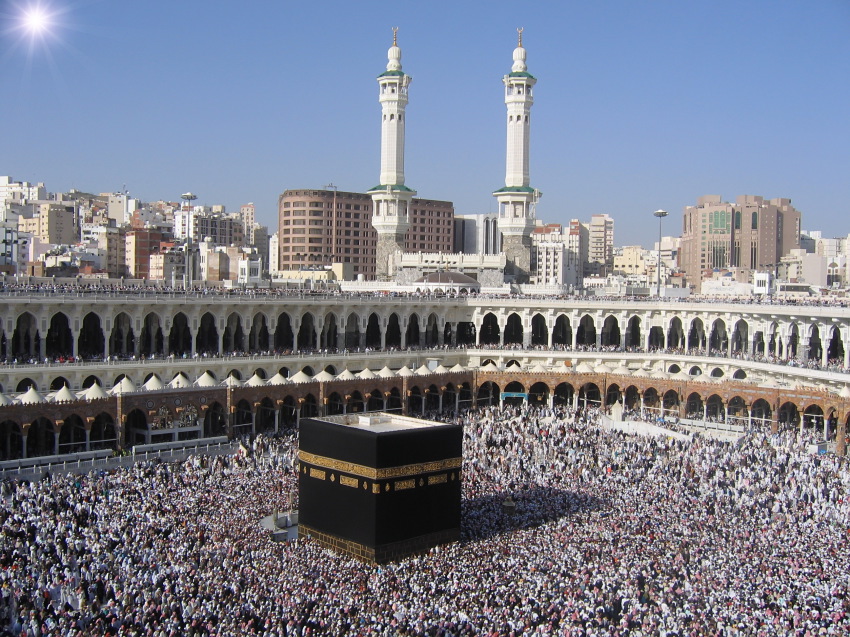
The Kabba. Mecca, Saudi Arabia.
According to Islamic tradition, the cube-shaped Kabba dates back to the time of Abraham. It is the most sacred Muslim site, and the location towards which all Muslims face during prayer.
The Islamic calendar (or Hijri calendar) is a purely lunar calendar. It contains 12 months that are based on the motion of the moon, and because 12 synodic months is only 12 x 29.53=354.36 days, the Islamic calendar is consistently shorter than a tropical year, and therefore it shifts with respect to the Christian calendar.
The calendar is based on the Qur'an (Sura IX, 36-37) and its proper observance is a sacred duty for Muslims.
The Islamic calendar is the official calendar in countries around the Gulf, especially Saudi Arabia. But other Muslim countries use the Gregorian calendar for civil purposes and only turn to the Islamic calendar for religious purposes.
What does an Islamic year look like?
The names of the 12 months that comprise the Islamic year are:
| 1. Muharram | 7. Rajab |
| 2. Safar | 8. Sha'ban |
| 3. Rabi’ al-awwal (Rabi’ I) | 9. Ramadan |
| 4. Rabi’ al-thani (Rabi’ II) | 10. Shawwal |
| 5. Jumada al-awwal (Jumada I) | 11. Dhu al-Qi'dah |
| 6. Jumada al-thani (Jumada II) | 12. Dhu al-Hijjah |
(Due to different transliterations of the Arabic alphabet, other spellings of the months are possible.)
Each month starts when the lunar crescent is first seen (by a human observer’s eye) after a new moon.
Although new moons may be calculated quite precisely, the actual visibility of the crescent is much more difficult to predict. It depends on factors such as weather, the optical properties of the atmosphere, and the location of the observer. It is therefore very difficult to give accurate information in advance about when a new month will start.
Furthermore, some Muslims depend on a local sighting of the moon, whereas others depend on a sighting by authorities somewhere in the Muslim world. Both are valid Islamic practices, but they may lead to different starting days for the months.
So you can’t print an Islamic calendar in advance?
Not a reliable one. However, calendars are printed for planning purposes, but such calendars are based on estimates of the visibility of the lunar crescent, and the actual month may start a day earlier or later than predicted in the printed calendar.
Different methods for estimating the calendars are used.
Some sources mention a crude system in which all odd numbered months have 30 days and all even numbered months have 29 days with an extra day added to the last month in ‘leap years’ (a concept otherwise unknown in the calendar). Leap years could then be years in which the number year mod 30 is one of the following: 2, 5, 7, 10, 13, 16, 18, 21, 24, 26, or 29. (This is the algorithm used in the calendar program of the Gnu Emacs editor.)
Such a calendar would give an average month length of 29.53056 days, which is quite close to the synodic month of 29.53059 days,so on the average it would be quite accurate, but in any given month it is still just a rough estimate.
Better algorithms for estimating the visibility of the new moon have been devised.
How does one count years?
Years are counted since the Hijra, that is, Mohammed’s emigration to Medina in AD 622. On 16 July (Julian calendar) of that year, AH 1 started (AH = Anno Hegirae = year of the Hijra).
In the year AD 2003 we have witnessed the start of Islamic year AH 1424.
Note that although only 2003-622=1381 years have passed in the Christian calendar, 1423 years have passed in the Islamic calendar, because its year is consistently shorter (by about 11 days) than the tropical year used by the Christian calendar.
When will the Islamic calendar overtake the Gregorian calendar?
As the year in the Islamic calendar is about 11 days shorter than the year in the Christian calendar, the Islamic years are slowly gaining in on the Christian years. But it will be many years before the two coincide. The 1st day of the 5th month of C.E. 20874 in the Gregorian calendar will also be (approximately) the 1st day of the 5th month of AH 20874 of the Islamic calendar.
Doesn’t Saudi Arabia have special rules?
For civil (but not religious) purposes, Saudi Arabia doesn’t rely on a visual sighting of the crescent moon to fix the start of a new month. Instead they base their calendar on a calculated astronomical moon.
Since 2002 (AH 1423) the rule has been as follows: If on the 29th day of an Islamic month,
- the geocentric conjunction (that is, the new moon as seen from the centre of the earth) occurs before sunset, and
- the moon sets after the sun,
then the next day will be the first of a new month; otherwise the next day will be the last (30th) of the current month.
The times for the setting of the sun and the moon are calculated for the coordinates of Mecca
islamic Apps
iPray for iPhone

The Hadith Software

By IslamaSoft
This is a Hadith Software with English translated hadith (plug-in) databases all bundled together in one easy to use application. The software is equipped with an explorer type user interface for ease of use. It has the ability to export hadiths books/chapters to a text editor (e.g. Notepad), bookmarks, advanced search engine (super fast), active marker ‘highlight text’ display, and allows hadiths to be sent to anyone via email and more.
Quran Explorer

By www.quranexplorer.com
Latest Quran software for iPhone and iPad. Free version features:
- Complete Quran Arabic text
- Option to display side by side English translation by Mufti Taqi Usmani
- Beautiful Uthmanic script font
- Hi-resolution retina display support for iPhone 4
- Complete audio recitation of famous Qari (Sheikh Mishari Rashid)
- Bookmarking (upto 3 bookmarks)
- Bulk download (for last ten sura only)
- Portrait and landscape mode
- Scalable font sizes
- Sura and Juz index
- High quality audio recitation with ayah highlighting
- Pinch/zoom feature for changing font size
- Fast audio playback through robust download method with progress icon
- Colored ayah marking to show downloaded audio
- Contextual toolbar on double tap
- Option to update existing content (for fixing errors in Quran text, translation or audio)
- Go to ayah feature QuranExplorer free version has complete scalable Quran Text in Uthmanic font with all diacritical marks.
English translation by Mufti Taqi Usmani is also included. Quran Explorer is compatible with both iPhone and iPad in all orientations. It supports pinch/zoom feature for changing font size. English translation appears side by side. Complete Arabic text and English translation has been proof-read by a Muslim scholar (‘alim).
Paid version contain many translations, many reciters, English and Urdu translation audio, unlimited bookmarks, background audio, disable standby feature, bulk download and many more features.
Download from the App Store
The Noble Quran Version 3.0

By IslamaSoft
Translated by Marmaduke Pikthall. The software has an excellent easy-to-use explorer type user interface with the ability to change themes, bookmarks, advanced search engine, and the ability to display additional information relating to
each chapter. And, most importantly, it displays text in both Arabic and English transliteration together with English translation
Friday, March 8, 2013
Sayings of The Holy Prophet Muhammad (SAW)

People from the time of Adam onward are as equal as the teeth of a comb. Arabs are not superior to non Arabs, nor are Red skinned people better than Blacks. No superiority or virtue exists except in terms of Piety.
Hail to those who are so concerned with improving their own faults, that they abstain from preoccupation with the flaws of other believers.
He, who is a parasite to others, shall be condemned in the eyes of God, the Almighty.
The Quest for knowledge I cherish, superior to God's worship.
The most virtuous from among you are those privileged with scrupulous manners. Likewise, they associate with others; while they also get along with them.
He who indulges in a task without proper knowledge will deteriorate rather than improve the case.
He, who betrays the vicious deed of another in public, it is as though he has initiated the evil act himself.
Do not argue with your brother, nor depress him with sarcastic humor, and do not make a promise so as to fail in fulfilling your covenant.
Whensoever you are presented with a gift, make efforts to return the deed; if it is beyond your ability express your gratitude in words.
Do not set up to accomplish a virtuous deed pretentiously, However, do not abandon righteousness due to shyness.
Whomsoever initiates a graceful tradition; shall be rewarded as long as that tradition is sustained.
There is no good in extravagance however, there can never be extravagance in good deeds.
Opportunities slide away like clouds.
Victory is gained by resolution and determination.
During the days of your life, divine breezes will blow, so watch out for them.
Establish contact with those who have severed relations with you, and be good to those who have treated you badly.
He who covets another's property, his sorrow shall be prolonged.
Whenever a wise and sincere man advises you, take heed and welcome it gladly.
There are two characteristics which cannot be found together in a believer; Avarice and a Vicious temper.
Blessed be those who spend their excess wealth and abstain from excessive talk.
He who calls upon his fellow Believer without their being any need, is destined to be among God's visitors.
Whomsoever satisfies the need of a fellow Believer God shall meet his many needs.
The most vicious among all men is he who is respected out of fear.
I restrain you from three traits of character: Envy, Avarice and Arrogance.
The true Muslim is the one from whose hand and tongue other Muslims are safe.
Excessive requests from people lead to humiliation.
Beware of obstinacy; since it begins with foolishness and ends in regret.
Whatever you hate for yourself hate for others, and whatever you like for yourself , like for your brother.
Adopt a cordial attitude towards your relatives and neighbours and with whomever you keep company and associate.
There is no worship like Meditation, and there is no support more sure.
Beware of too much laughter, since it mortifies the heart.
Appreciate five things before five others: Your Youth before your Old age, Your Health before your illness, Your Wealth before your Poverty, Your Spare Time before your hard work and Your Life before Death.
T'is better to associate with a good friend than to remain in solitude, while being alone is better than dealing with a vicious companion.
Be neither a fault finder, an eulogist, a defamer nor a wrangler.
Social gatherings should be marked by good faith, divulging the secret of a friend is breach of faith.
I restrain you from abandoning your fellow Believers: Though in case you are obliged to do so, it should not last for more than three days.
He who is in a position to administer punishment should all the more be encouraged to forgive.
The best of men is he who refrains from that which does not concern him.
The best attire of man is severity associated with faith.
Take care not to abuse a Muslim, or accuse an honest man of lying.
There is no quicker way to receive punishment than by committing an outrage.
Subscribe to:
Posts (Atom)